Blockchain Facts: What Is It and Key Components

Codenova
Blockchain & Web Development Company

In recent years, blockchain technology has emerged as a revolutionary force, promising to transform various industries, from finance to supply chain management. But what exactly is blockchain, and how does it work? In this blog post, we’ll break down the fundamentals of blockchain technology in simple terms.
What is Blockchain?
Blockchain technology is a decentralized, distributed ledger system that enables the secure and transparent recording of transactions across a network of computers. Unlike traditional centralized systems, where a single authority controls the ledger, blockchain operates on a peer-to-peer network, where each participant (or node) has a copy of the entire ledger.
How Does a Blockchain Work?
You might be familiar with spreadsheets or databases. A blockchain is somewhat similar because it is a database where information is entered and stored. However, the key difference between a traditional database or spreadsheet and a blockchain is how the data is structured and accessed.
A blockchain consists of programs called scripts that conduct the tasks you usually would in a database: Entering and accessing information and saving and storing it somewhere. The blockchain collects transaction information and enters it into a block, like a cell in a spreadsheet containing information. Once it is full, the information is run through an encryption algorithm, which creates a hexadecimal number called the hash.
Key Components of Blockchain:
- Decentralization: Blockchain removes the need for a central authority by distributing control and ownership of the ledger among network participants. This decentralization enhances security, transparency, and trust, as no single entity has control over the entire system.
- Blocks and Transactions: Transactions are the basic units of data in a blockchain. They contain information about the sender, receiver, and the amount of the transaction. These transactions are grouped together into blocks, which are then added to the blockchain in a sequential and immutable manner.
- Consensus Mechanism: Before a block can be added to the blockchain, it must be validated by the network through a consensus mechanism. Consensus mechanisms, such as Proof of Work (PoW), Proof of Stake (PoS), and Delegated Proof of Stake (DPoS), ensure agreement among network participants and prevent double-spending and fraud.
- Immutability: Once a block is added to the blockchain, it becomes immutable, meaning that it cannot be altered or deleted. This is achieved through cryptographic hashing, where each block contains a unique cryptographic hash of the previous block. Any attempt to modify a block would require changing the hash of all subsequent blocks, making it practically impossible to tamper with the data.
- Transparency and Security: Since every participant in the network has a copy of the ledger, blockchain provides transparency and accountability, as all transactions are visible to everyone. Moreover, the cryptographic algorithms used in blockchain ensure data integrity and security, making it resistant to censorship and cyber-attacks.
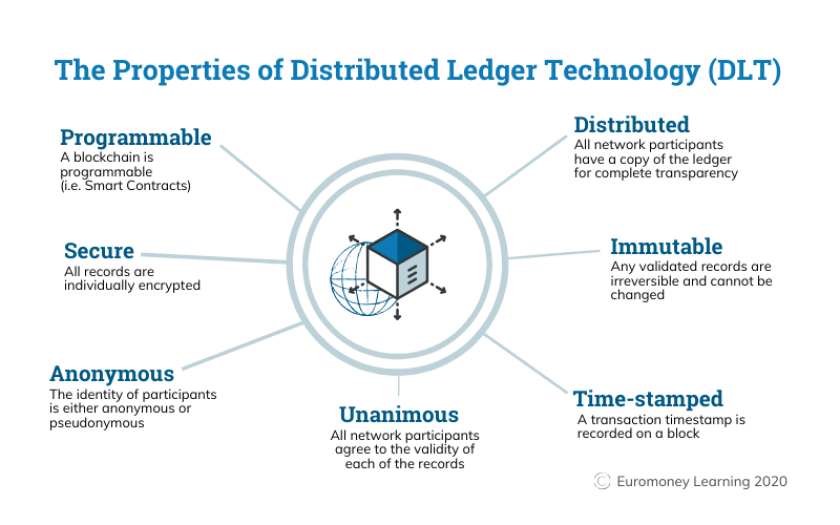
(DLT)
Real-World Applications of Blockchain
- Blockchain technology has a wide range of applications across various industries, offering solutions to challenges related to transparency, security, and efficiency. Some of the real-world applications of blockchain include:
- Cryptocurrencies: Bitcoin, Ethereum, and other cryptocurrencies are built on blockchain technology. They enable peer-to-peer transactions without the need for intermediaries like banks, providing financial inclusion and autonomy to users worldwide.
- Supply Chain Management: Blockchain can be used to track the movement of goods throughout the supply chain, from manufacturing to delivery. By recording every transaction and movement of products on a transparent and immutable ledger, blockchain enhances transparency, reduces fraud, and ensures the authenticity and quality of products.
- Smart Contracts: Blockchain enables the creation and execution of self-executing contracts, known as smart contracts. Smart contracts automatically enforce the terms of an agreement when predefined conditions are met, without the need for intermediaries. This reduces the risk of fraud, increases efficiency, and lowers transaction costs in various industries, including real estate, insurance, and legal services.
- Identity Verification: Blockchain can provide secure and decentralized identity verification, enabling individuals to control and share their personal data without relying on centralized authorities. This can help in reducing identity theft, streamlining identity verification processes, and providing access to services for underserved populations.
- Healthcare: Blockchain can be used to securely share medical records among healthcare providers while maintaining patient privacy. By providing a tamper-proof and transparent record of patient data, blockchain can improve interoperability, reduce administrative costs, and enhance patient outcomes in the healthcare industry.
- Voting Systems: Blockchain technology has the potential to revolutionize voting systems by providing secure, transparent, and tamper-proof digital voting solutions. Blockchain-based voting systems can ensure the integrity of elections, prevent voter fraud, and increase voter participation by providing accessible and convenient voting options.
- Digital Asset Management: Blockchain can be used to tokenize and manage digital assets, such as real estate, artwork, and intellectual property. By representing physical or digital assets as digital tokens on a blockchain, blockchain-based asset management platforms enable fractional ownership, automated asset transfer, and transparent ownership records.
Key considerations and challenges
- Permissioned vs. Permissionless Blockchains: It might be beneficial to briefly explain the difference between permissioned and permissionless blockchains. Permissionless blockchains, like Bitcoin and Ethereum, allow anyone to participate in the network and validate transactions. In contrast, permissioned blockchains restrict participation to authorized entities, making them suitable for enterprise use cases where privacy and control are paramount.
- Scalability Challenges: It’s worth mentioning that scalability is one of the ongoing challenges facing blockchain technology. While blockchain offers many benefits, such as decentralization and security, it currently struggles with scalability issues, particularly in public blockchains with high transaction volumes. Various scaling solutions, such as sharding and layer 2 protocols, are being explored to address these challenges and improve blockchain scalability.
- Environmental Concerns: Another aspect to consider is the environmental impact of blockchain, particularly proof-of-work (PoW) consensus mechanisms used by some blockchains, such as Bitcoin. PoW requires significant computational power and energy consumption, leading to concerns about carbon emissions and sustainability. It’s important to highlight ongoing efforts to develop more energy-efficient consensus mechanisms, such as proof-of-stake (PoS), to mitigate these environmental concerns.
- Regulatory Considerations: Blockchain technology operates in a complex regulatory landscape, with regulations varying significantly across jurisdictions. It’s essential to address the regulatory considerations and challenges facing blockchain adoption, including issues related to compliance, taxation, and legal recognition of blockchain-based assets and transactions.
Conclusion
Blockchain technology has emerged as a transformative force with the potential to revolutionize various industries and reshape the way we transact, communicate, and interact with digital assets. By providing a decentralized, transparent, and secure platform for recording transactions and exchanging data, blockchain offers solutions to longstanding challenges related to trust, security, and efficiency. As the technology continues to evolve and mature, we can expect to see even more innovative applications of blockchain in the years to come, driving further adoption and disruption across industries.
#Blockchain #CryptoEducation #DecentralizedRevolution #TechExplained #DigitalInnovation #BlockchainApplications #CryptoFundamentals #TransparentTransactions #SmartContracts #FutureTechTrends #ArizonInfotech #Hiring #Job #Develope